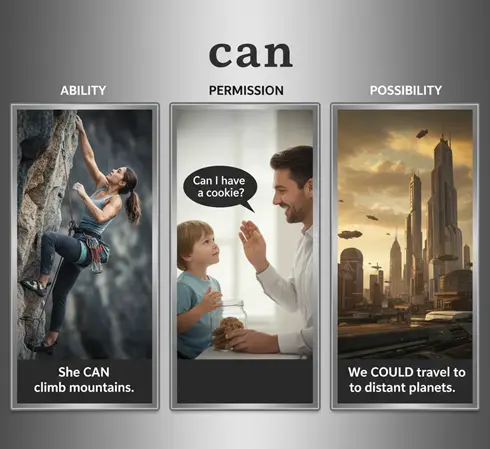
Can and could are two modals that indicate the content of the proposition is achievable. Can expresses what is possible, doable, or permitted in the present. Could expresses what was possible, doable, or permitted in the past, but also what is possible in a mitigated way in the present (suggestions, polite requests). These two modals have several overlapping functions: ability, permission, sporadicity, possibility, polite request, and suggestion. Welcome to the world of can and could — where "can" takes five different faces.
CAN: Five Main Functions
1. Ability or potential property of the subject (= be able to)
The subject has the ability to perform the action.
- Don't worry: you can do it!
- He can speak several languages.
Can = the subject possesses the aptitude or competence to do something.
2. Statement of permission (= be allowed to)
The subject has permission to do something.
- Employees can work from home on Fridays.
This isn't ability, but authorization observed.
3. Sporadicity (temporal or referential)
Temporal sporadicity (sometimes) :
- The weather here can change rapidly.
→ Sometimes the weather changes rapidly. Not always, but it's sporadically possible. Referential sporadicity (some of them) :
- These apples can be sour, so choose carefully.
→ Some apples are sour, not all. You need to be careful.
4. Possibility linked to external circumstances (= it is possible for someone to do something)
Circumstances make the action possible.
- Students can access the online library from home.
This is neither personal ability nor explicit permission, but a possibility offered by circumstances (technology enables this access). Two meanings derive from this function: A polite request :
- Can you open the window, please?
A suggestion :
- I can help you, if you want.
COULD: The Same Functions in the Past (and More)
Could takes the functions of can, but applied to the past. It also adds mitigation functions in the present.
1. Past ability (= was able to)
The subject had the ability in the past.
- He could speak several languages when he was young.
2. Statement of past permission (= was allowed to)
The subject had permission in the past.
- Under the former manager, employees could work from home on Fridays.
3. Past sporadicity (temporal or referential)
Past temporal sporadicity (sometimes in the past) :
- Traffic could be interrupted for long periods during the works.
→ Sometimes traffic was interrupted (during the construction period). Past referential sporadicity (some of them in the past) :
- At the time, he was a bit of a celebrity, and people could ask him for an autograph when he went out.
→ Some people (not all) would ask him for autographs.
4. Past possibility linked to external circumstances
Past circumstances made the action possible.
- Before the budget cuts, we could benefit from better equipment.
Two meanings derive from this function, but in the present (with mitigation) : An even more polite request than with can :
- Could you open the window, please?
Could is more polite than can because it creates distance by using the past form (even though the request is in the present). A mitigated suggestion :
- I could help you move the furniture this weekend.
Could softens the suggestion, making it less direct than "I can help you."
CAN vs BE ABLE TO vs MANAGE TO: Ability With or Without Achievement
Ability WITHOUT achievement of the event
With can (or could), we express potential ability, without specifying whether the action was carried out or not.
- He could solve this problem in record time.
→ He has this ability. But did he do it? We don't know.
Ability WITH or WITHOUT achievement (ambiguity)
Be able to can express ability with or without achievement, creating ambiguity.
- He was able to solve this problem in record time.
This can mean :
- He had the ability to do it (without specifying if he did)
- He succeeded in doing it (actual achievement)
Ability WITH achievement of the event
Manage to clearly expresses ability with actual achievement.
- He managed to solve this problem in record time.
→ He did it. It's a confirmed success. Summary :
- Can/could : potential ability (achievement not specified)
- Be able to : ability (ambiguous: achieved or not)
- Manage to : ability achieved successfully
CAN vs COULD: Key Differences
CAN (present) :
- Current ability : I can swim.
- Current permission : You can leave early.
- Present sporadicity : It can rain here.
- Present possibility : You can access the file online.
- Polite request : Can you help?
- Suggestion : I can help you.
COULD (past or mitigation) :
- Past ability : I could swim when I was five.
- Past permission : We could leave early under the old rules.
- Past sporadicity : It could rain for days.
- Past possibility : You could access the file before the update.
- Very polite request (present) : Could you help? (more polite than can)
- Mitigated suggestion (present) : I could help you. (less direct than can)
Politeness nuance :
- Can you help? = polite
- Could you help? = very polite
Suggestion nuance :
- I can help. = direct offer
- I could help. = mitigated offer, less insistent
Conclusion
Can and could aren't limited to "can." They express :
- Ability (physical, intellectual, competence)
- Permission (authorization)
- Sporadicity (sometimes, some)
- Possibility (favorable circumstances)
- Politeness (softened requests)
- Suggestions (mitigated offers)
Could takes all the functions of can in the past, but also adds a dimension of mitigation in the present for requests and suggestions. To express ability successfully achieved, prefer manage to over could or be able to, which remain ambiguous. Mastering can and could means understanding that "can" in English doesn't only mean "to have the ability" — it's also having permission, seizing possibility, and navigating nuances of politeness.