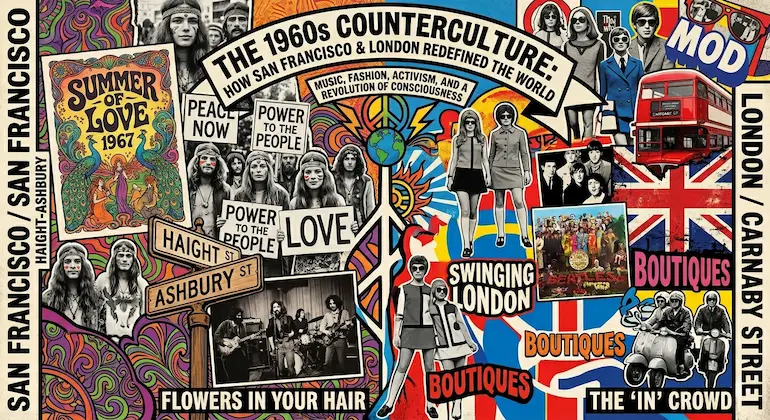
Some decades change everything. In the space of ten years, San Francisco and London became the epicentres of a cultural revolution that redefined music, fashion, language, and politics — a fundamental questioning of what it meant to live, dress, and resist.
The World Before: Why the Break Was Inevitable
Post-war society was built on a promise: work, family, and obedience. But the baby boom generation — born between 1945 and the early 1960s — ran headlong into its contradictions: the Vietnam War, racial segregation, and the atomic threat. This was the first generation with access to mass education and enough economic comfort to think differently. The result was a defining "generation gap" — a rupture between young people and a parental world they saw as hopelessly focused on material goods and blind conformity.
San Francisco and the Summer of Love
In 1967, San Francisco's Haight-Ashbury became the capital of the Summer of Love. Tens of thousands of young people — mostly white, middle-class Americans who felt alienated from mainstream values — rejected materialism in favour of community, peace, and psychedelia. Many let their hair grow long, wore colourful clothes, adopted vegetarian diets, and travelled the country in flower-painted Volkswagen vans. Their most famous slogan: "Make love, not war."
Music was at the heart of this: the "San Francisco Sound" produced monuments like Jefferson Airplane, Janis Joplin, and the Grateful Dead — whose devoted fans, known as Deadheads, made the band a symbol of countercultural belonging.
London: Swinging London and Fashion
Across the Atlantic, 1960s London was no longer grey and austere — it was Swinging London. Mary Quant invented the miniskirt on Carnaby Street, a political gesture asserting female autonomy. And British bands were dominating American charts: The Beatles, The Rolling Stones, and The Who. For the first time, cultural influence was flowing east to west — a complete reversal of the established order. The Who's My Generation (1965), with its defiant line "I hope I die before I get old," practically became the anthem of an entire youth movement.
The Language of the Counterculture
Many terms from this era are now common usage: Cool (relaxed approval), Groovy (well-being), The Establishment (entrenched power), and Flower Power (non-violent philosophy). Timothy Leary — the psychologist and LSD advocate whom President Nixon called "the most dangerous man in America" — gave the movement its ultimate slogan: "Turn on, tune in, drop out." Four words that defined a generation.
The Contradictions of a Revolution
Every revolution has its shadows. The counterculture ranged from nonviolent peaceniks to groups engaged in armed resistance — but the dream of a peaceful utopia shattered in late 1969. Woodstock drew an estimated 400,000 people in August: three days of music, mud, and collective euphoria. Four months later, the Altamont festival ended in tragedy when a concertgoer was fatally stabbed during a Rolling Stones performance. Drug use devastated many, leading to the tragic 27 Club — Janis Joplin, Jimi Hendrix, and Jim Morrison all died at 27 between 1970 and 1971. And the final irony: the industry rapidly co-opted the movement, selling rebellion as a commercial product.
Essential Vocabulary
- Counterculture — movement against the norm
- Hippie — proponent of the movement
- The Establishment — the ruling class
- Psychedelic — mind-expanding
- Generation gap — the cultural divide between youth and their parents
- Flower Power — non-violent resistance through symbols of peace
- Miniskirt — symbol of liberation
💡 Key takeaway: The 1960s counterculture is not just nostalgia — it is an origin point. The mass antiwar protests, the first Earth Day in 1970, the struggles for women's rights and civil rights: it all started here. The world we live in today still runs on ideas born in that decade.