You know your synonyms. You know that fast and quick both mean rapid, that total and complete overlap almost entirely, that heavy and strong both signal intensity.
And yet quick food is wrong. Strong rain is wrong. Nothing in the grammar forbids them; nobody says them.
Welcome to collocations — the pairings a language has quietly agreed on, and the synonyms it silently refuses.
What is a collocation?
A collocation is a word combination privileged by usage. It is not a grammar rule, and it is not a matter of logic. For historical and cultural reasons, certain words simply prefer certain partners, and turn their synonyms away at the door.
Two features distinguish a collocation from an idiom:
- It is transparent. Heavy rain means rain that is heavy. To kick the bucket does not mean anything about buckets — that is an idiom.
- It is only semi-fixed. You can say very heavy rain, the rain was heavy, heavier rain. An idiom resists that kind of surgery.
That combination — perfectly understandable, yet not freely substitutable — is exactly what makes collocations invisible to learners and lethal in translation.
Collocations come in types
Recognising the pattern makes them far easier to hunt down:
- adjective + noun — heavy rain, strong coffee, a narrow escape
- verb + noun — make a decision, take a shower, pay attention, commit a crime
- adverb + adjective — deeply concerned, bitterly disappointed, fully aware
- verb + adverb — apologise profusely, flatly refuse
- noun + noun — a round of applause, a pang of guilt
The verb + noun family is where French speakers lose most points, because French and English pick different support verbs for the same action.
Synonyms that are not quite synonyms
Total, complete — and the asymmetry between the two languages
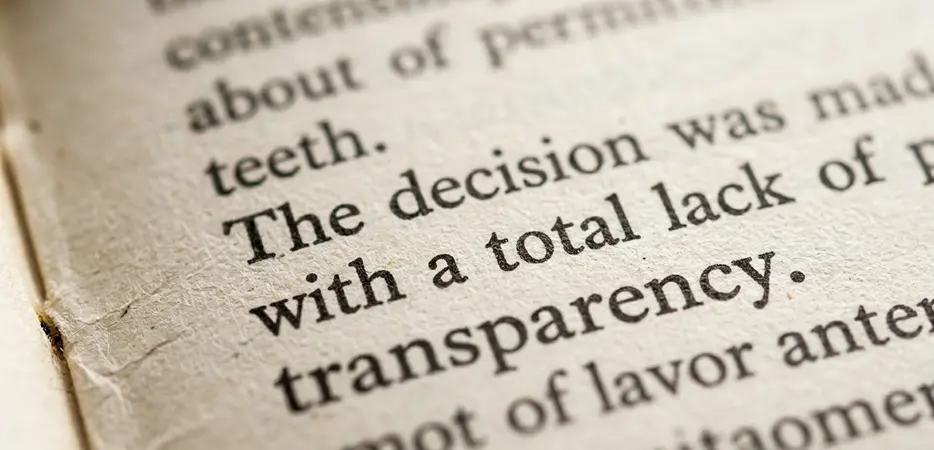
A total lack of… ↔ Un manque total de…
English tolerates both a total lack of and a complete lack of — the second is perfectly current, if slightly weightier. French does not offer that freedom: un manque total is the natural phrase, while un manque complet is at best awkward.
This asymmetry is the real lesson. A collocational constraint in one language does not imply a matching constraint in the other, so you cannot reason your way from English usage to French usage or back. Each pairing has to be verified in its own language.
And notice that collocations are gradient rather than binary: some combinations are impossible, others merely unusual, and a great deal of translation quality lives in that gap.
Fast, quick and the high-speed train
Fast food, never quick food. Both adjectives mean rapid; only one was chosen by the American restaurant industry in the 1950s, and the pairing fossilised.
A fast train ↔ Un train à grande vitesse.
French does not say un train rapide in the modern technical sense; it says à grande vitesse, a phrase institutionalised by the SNCF with the TGV. Un train à vitesse élevée is not illogical — it is simply never said, which in matters of collocation is the same thing.
Happy marriage, successful career
A happy marriage ↔ Un mariage heureux.
Both languages default to happy. English does allow a successful marriage, but it says something slightly different — a marriage that worked, viewed from outside — whereas French un mariage réussi sounds distinctly odd outside a wedding-planning context.
Compare a successful career ↔ une carrière réussie, which both languages accept without hesitation. Same adjective, same two languages, opposite verdicts, depending entirely on the noun it is attached to.
Attached, annexed
Please find attached… ↔ Veuillez trouver ci-joint…
Annexed and ci-annexé exist and mean roughly the same thing, but neither belongs to ordinary correspondence. Professional formulas are collocations hardened into ritual: you do not compose them, you reproduce them.
Where French speakers trip in English
The support verb is the classic trap, because French and English almost never choose the same one:
- to make a decision ↔ prendre une décision (French takes, English makes)
- to take a nap ↔ faire une sieste (the reverse)
- to brush your teeth ↔ se laver les dents (French washes them)
- heavy rain ↔ une pluie battante (beating, not heavy)
- strong coffee ↔ un café serré (tight)
- to be good at maths ↔ être fort en maths (strong)
- to set the table ↔ mettre la table
None of these mismatches is meaningful. There is no hidden cultural insight in the fact that the French wash their teeth. That is precisely the point: the pairing is arbitrary, and therefore it has to be learned rather than deduced.
Why collocations matter so much in translation
They are the difference between a text that is correct and a text that is native.
A translator can know every word in a sentence, understand its meaning perfectly, and still produce a combination that sounds manufactured. Nothing in the result is identifiably wrong — and yet every reader senses that something is off, the way mismatched shoes are noticed without being analysed.
Worse, collocation errors are invisible to their author. Grammar mistakes trigger an alarm; a bad pairing does not, especially when the source language has authorised it. This is interference at its purest, and it is why revision by a native speaker still has no substitute.
How do you learn them?
There is no shortcut, but there is a method:
- Learn the block, not the word. Record make a decision, never decision alone. A vocabulary list of isolated words trains you to build combinations that do not exist.
- Read and listen in volume. Collocational intuition is statistical: it builds through exposure to authentic material, not through rules.
- Use collocation dictionaries. They exist, and they are exactly the right tool — the Oxford Collocations Dictionary and the BBI list, for any given noun, the verbs and adjectives that actually accompany it.
- Check against a corpus. When hesitating between two pairings, compare their frequency in a large corpus of real English rather than asking which is more logical. Logic will lie to you here.
- Mistrust the bilingual reflex. If a phrase maps word for word onto your native language and feels too easy, verify it. Comfort is the warning sign.
- Get it wrong once. Say quick food, be corrected, and never forget it again. Corrected errors are the most durable memory device in language learning.
The apparent arbitrariness hides a social history
What makes collocations fascinating is that their arbitrariness is only apparent: they record the collective history of a usage.
Fast food stuck because that is how an American industry named itself in the 1950s. Train à grande vitesse stuck because of a French industrial programme in the 1980s. In both cases a contingent choice became, through repetition, the only acceptable form.
Collocations are social conventions crystallised into language. They follow the logic of collective use, not the logic of the dictionary — which is why no amount of reasoning will reconstruct them, and why they date a text so precisely.
Translating means choosing the right pairs
When you translate you are not only choosing words. You are choosing pairings, established associations, linguistic marriages that usage has already blessed.
A good translator knows that one synonym cannot simply be swapped for another, and that every word carries its own preferences, habits and loyalties.
Because when it comes to collocations, words behave like people: they have their affinities.
And in French, manque has chosen total. Complet is not invited to the dance — even though, logically, it would make no difference at all.